
Table of Contents
Introduction
Buying a villa in Bangalore is all about embracing a lifestyle filled with space, privacy, and comfort. Imagine having your own private garden, roomy bedrooms, and the perks of a gated community—it’s no wonder villas are so attractive to families.
However, there’s a crucial question that needs your attention before you make that purchase: What will the monthly maintenance costs look like?
While the price tag on a villa gives you an idea of the initial investment, it doesn’t shed light on the ongoing expenses that come with owning and maintaining the property.
From security and landscaping to clubhouse amenities, water management, and repairs, these costs can add up and significantly impact your monthly budget.
By understanding the villa maintenance cost in Bangalore, you can make more informed comparisons between different residential communities and better prepare for the long haul of ownership.
This guide will walk you through how maintenance charges work, what they typically cover, how to estimate your monthly expenses, and what potential buyers in Sarjapur Road and other neighborhoods in Bangalore should keep an eye out for before diving in.
How Much Does Villa Maintenance Cost in Bangalore?
When it comes to villa maintenance costs in Bangalore, there’s quite a bit of variation based on factors like the size of the property, the amenities offered by the community, security features, and how maintenance fees are calculated. Some market guides for 2026 suggest that you might expect to pay around ₹10,000 to ₹18,000 each month for a villa sized between 3,000 and 3,500 sq. ft. in a mid-range gated community. Keep in mind, though, that this isn’t a verified average for all of Bangalore, nor is it a one-size-fits-all rate for every project.
If you’re looking at a smaller residential community with fewer amenities, the fees could be lower. On the flip side, a high-end villa development that boasts lush landscaping, a clubhouse, and sports facilities might come with a heftier price tag.
It’s always a good idea for buyers to ask for the actual maintenance schedule or a written estimate from either the developer or the residents’ association.
Also, remember that the monthly association fee might not cover individual villa repairs, private gardening, household utilities, or property taxes.

What Are Villa Maintenance Charges?
Villa maintenance charges are regular payments that help keep the shared services and infrastructure running smoothly in a residential community.
These fees are essential for taking care of common areas and facilities that everyone uses.
For instance, in a gated community, you might need to hire security staff, housekeeping teams, and landscaping professionals to look after shared water and electrical systems.
If the development has extra amenities, there could also be costs associated with maintaining swimming pools, gyms, sports courts, and a clubhouse.
The amount each villa owner contributes is determined by the community’s approved budget and how expenses are allocated among residents.
What Is Usually Included?
Common maintenance expenses may cover:
Security guards and entrance management
CCTV systems and common-area lighting
Cleaning of internal roads and shared spaces
Clubhouse and swimming pool maintenance
Landscaping and common garden upkeep
Shared water pumps and sewage treatment systems
Waste management and housekeeping
Repairs to common infrastructure
Facility-management and administrative expenses
Not all villa communities provide the same services.
Before comparing two properties, ask for an itemised list of what their maintenance fees actually cover.
How Are Monthly Villa Maintenance Charges Calculated?
When it comes to monthly villa maintenance, there are a few ways to figure out the costs. You might base it on the built-up area, the plot size, or even split it evenly among all the villas, depending on what’s laid out in your agreement and the association rules.
Some developments prefer to set a maintenance rate per square foot, while others take the total annual community budget and divide it among the owners based on their agreed-upon contribution structure.
Villa Maintenance Calculation Formula
When a community uses an area-based monthly rate, the formula looks like this:
Monthly Maintenance = Chargeable Area × Monthly Rate per Sq. Ft.
Let’s take a hypothetical villa as an example, which has a chargeable area of 3,200 sq. ft.
If the maintenance rate is set at ₹4 per sq. ft., the calculation would be:
3,200 × ₹4 = ₹12,800 each month.
To find out the annual cost, you simply multiply that monthly amount by 12:
₹12,800 × 12 = ₹1,53,600.
Keep in mind, this is just a sample calculation and not an official quote from any developer.
Sample Monthly Maintenance Calculation
| Rate per Sq. Ft. | 3,000 Sq. Ft. Villa | 4,000 Sq. Ft. Villa |
|---|---|---|
| ₹3 | ₹9,000 | ₹12,000 |
| ₹4 | ₹12,000 | ₹16,000 |
| ₹5 | ₹15,000 | ₹20,000 |
These examples are great for showing how the calculation operates, but they don’t set the market rate for any specific project.
It’s also important to verify the chargeable area. A developer might choose to use the built-up area, another specified area, or even a completely different billing approach.
Villa Maintenance Charges in Sarjapur: What Should Buyers Expect?
Sarjapur Road is a key residential area in southeast Bangalore, featuring a mix of independent villas and gated communities around Gunjur, Varthur, Dommasandra, Muthanallur, and along the Sarjapur–Attibele stretch.
These neighborhoods come in all shapes and sizes, each with its own set of amenities and maintenance needs.
Because of this variety, you can’t pin down a single maintenance fee for villas in Sarjapur.
For instance, a community with a wealth of shared facilities will likely face higher operating costs compared to one that just provides basic security and well-kept internal roads.
On the flip side, a smaller development doesn’t necessarily mean lower fees.
When there are fewer villa owners sharing fixed costs like security staff and water treatment systems, each owner’s share can still end up being quite significant.
Why Sarjapur Villa Maintenance Charges Differ
There are several factors that can impact your monthly bill:
Community size: This refers to how many occupied villas are sharing the costs for common services.
Amenities: Things like swimming pools, clubhouses, sports facilities, and beautifully landscaped areas all need regular maintenance.
Water infrastructure: The costs associated with pumping, storage, treatment, and any additional water arrangements can really affect your expenses.
Security arrangements: The costs for staffing, surveillance equipment, and visitor management systems can add up over time.
Management quality: How well vendor contracts are handled, the servicing of equipment, and the clarity of budgeting can all play a role in your overall spending.
If you’re a homebuyer looking at villas on Sarjapur Road, it’s important to consider maintenance obligations in addition to project prices, layouts, amenities, and locations.
Remember, just because a villa has the lowest purchase price doesn’t mean it will lead to the lowest long-term ownership costs.

Gated Community Villa Maintenance vs Independent Villa Maintenance
There is an important difference between maintaining a villa inside a gated community and maintaining an independent house outside a managed residential development.
Gated Community Villas
Residents generally contribute towards common-area services and facilities through an association or appointed maintenance agency.
Owners may also be responsible for individual home repairs and private outdoor areas.
This means a gated villa can have two different maintenance expenses: shared community charges and private property upkeep.
Independent Villas Outside Gated Communities
A standalone villa may not involve a formal community maintenance charge.
However, the homeowner remains responsible for organising repairs, security arrangements, water infrastructure, exterior upkeep and other essential services.
Therefore, having no monthly association fee does not mean that maintaining the property is free.
The better comparison is the total annual amount spent maintaining the home and its surrounding facilities.
How Do Clubhouse Amenities Affect Villa Maintenance Costs?
One of the key things that sets residential communities apart is the variety of facilities they offer.
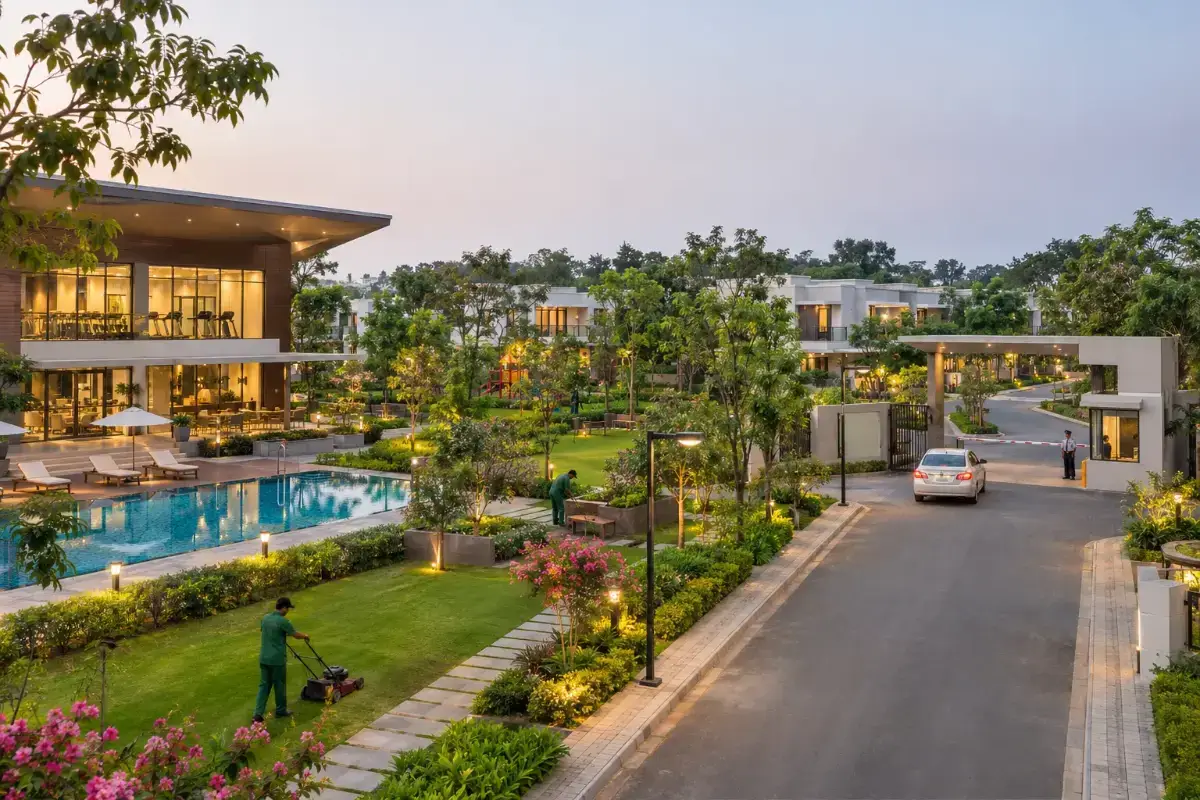
Take a premium gated community, for instance; it might boast amenities like swimming pools, gyms, recreational areas, beautifully landscaped gardens, and inviting common spaces for gatherings.
While these facilities certainly enhance convenience, they also come with the need for regular upkeep.
For example, swimming pools require cleaning, filtration, and water treatment services. Gyms need their equipment serviced, and those lovely gardens need proper irrigation and gardening care.
If you’re considering NVT Whispering Hues near Greenwood High International School, you might want to check out its advertised clubhouse, swimming pool, landscaped areas, and private backyard features.
These amenities are important to think about when budgeting for future maintenance costs.
However, don’t assume that the advertised amenities will give you a clear picture of the monthly maintenance fees for that project.
Before you commit to buying an under-construction villa, it’s wise to ask the developer about which facilities are included in the approved development and how the maintenance costs will be shared among residents.
What Maintenance Costs Are Not Included in the Monthly Bill?
An association’s monthly maintenance charge generally focuses on shared services.
Individual villa maintenance may be the homeowner’s separate responsibility.
This can include plumbing repairs, electrical work, repainting, waterproofing, garden maintenance and replacement of household equipment.
Private Garden and Landscaping
A villa with a private backyard may require regular lawn care, pruning, irrigation and seasonal plant maintenance.
The expense depends on the garden size and whether owners maintain it themselves or hire professional help.
Plumbing and Electrical Repairs
Leaks, damaged fixtures, wiring problems and equipment failures may require individual repairs.
These costs should be considered separately from community maintenance.
Exterior Painting and Waterproofing
Exterior walls, balconies, terraces and roofs may need periodic inspection and maintenance.
Bangalore’s seasonal rainfall makes proper drainage and waterproofing especially important.
Private Equipment
Air conditioners, water purifiers, pumps, backup systems and other equipment may require servicing or replacement over time.
Creating a separate repair reserve can make these occasional costs easier to manage.
Maintenance Planning for Larger 4 BHK Villas
When it comes to larger villas, their maintenance needs can differ quite a bit from those of smaller residential homes.
These spacious properties often feature expansive living areas, multiple bathrooms, terraces, private gardens, and a variety of electrical or mechanical systems that require attention.
Take, for instance, NVT Under the Open Sky, a charming villa community located at Budigere Cross, just off Old Madras Road in East Bangalore, which is a bit outside the Sarjapur corridor.
The developer offers 74 four-bedroom villas, with sizes ranging from around 3,446 to 4,240 sq. ft.
These larger villa layouts highlight the importance of considering individual property maintenance alongside the shared costs of the community.
That said, it’s worth noting that NVT Under the Open Sky isn’t situated on Sarjapur Road, so its monthly maintenance fees shouldn’t be seen as typical for developments in Sarjapur.
If you’re looking at any large villa, be sure to inquire whether the maintenance estimate covers things like private gardens, shared clubhouse amenities, backup power systems, and contributions for long-term repairs.
Monthly Maintenance vs Corpus Fund vs Advance Maintenance
When buying a villa, it’s important to be aware that there are several additional charges beyond just the property price.
While these costs are often listed together on a cost sheet, each one serves its own unique purpose.
Monthly Maintenance
This is the regular fee you pay for shared services like security, housekeeping, utilities, and facility management.
Advance Maintenance
Some developers ask for maintenance fees upfront for a certain period, either before or at the time of possession.
This fee is typically meant to cover the initial operating costs, as outlined in your agreement.
Corpus Fund
A corpus fund is usually collected to set aside money for the community’s long-term needs.
Details about the amount, ownership, allowed uses, and transfer rules should be clearly laid out in the relevant documents.
Sinking Fund
A sinking fund might be created to cover significant future expenses, such as road repairs, replacing equipment, or major infrastructure projects for the community.
It’s crucial for buyers to understand that a corpus fund, advance maintenance payment, and sinking fund are not the same thing.
Make sure to request a written breakdown of each charge, including whether it can be refunded, applied to future bills, or transferred to the owners’ association.
Is GST Applicable to Villa Maintenance Charges in Bangalore?
GST is an important factor when estimating recurring maintenance costs.
Under CBIC Circular No. 109/28/2019-GST, a qualifying residential welfare association’s contribution of up to ₹7,500 per member per month is covered by the stated exemption.
The circular also explains the relevance of the association’s ₹20 lakh aggregate annual turnover threshold.
Under the conditions described in that circular, where both the relevant turnover threshold and the ₹7,500 monthly contribution threshold are exceeded, GST at 18% applies to the full taxable contribution rather than only the excess amount.
However, GST treatment can depend on the association’s legal structure, the nature of supplies and subsequent legal developments.
Buyers should confirm the current applicable treatment with the association and a qualified tax professional rather than assuming that every maintenance payment above ₹7,500 automatically attracts GST.
Official reference: CBIC Circular No. 109/28/2019-GST
Do Sky Villas Have Different Maintenance Costs?
Properties marketed as sky villas may offer larger residences with villa-inspired designs inside a multistorey residential building.
Their maintenance arrangements can differ from those of ground-oriented independent villas.
High-rise developments may require shared expenses for lifts, common electricity, fire-safety systems, building maintenance and other infrastructure.
Traditional gated villa communities may allocate more expenditure to internal roads, landscaping, boundary maintenance and ground-level common facilities.
For example, NVT Sky Villas is presented on your website as a proposed high-rise residential phase within the NVT A Wonderful World township along Sarjapur–Attibele Road.
Buyers comparing such residences with independent villas should evaluate the approved property type, chargeable area, facilities and maintenance agreement.
A sky villa should not automatically be treated as an independent land-based villa when calculating ownership expenses.
Who Is Responsible for Villa Maintenance Before and After Possession?
Maintenance responsibility may change as a residential community develops.
During the initial development period, a builder may arrange shared services through a facility-management agency.
Section 11(4)(d) of the Real Estate (Regulation and Development) Act, 2016 requires the promoter to provide and maintain essential services on reasonable charges until the association of allottees takes over maintenance.
After the applicable handover, the owners’ association may manage the community budget and maintenance services in accordance with the governing rules.
Before purchasing, ask who currently manages the community, when the handover is expected and how residents can review expenses.
For a completed project, request recent maintenance bills and financial statements where available.
For an upcoming development, obtain the maintenance estimate and payment terms in writing.
What Should Buyers Check in an Upcoming Villa Project?
Buying an upcoming villa requires careful attention to the expenses that may begin after possession.
At the marketing or pre-launch stage, a developer may not have a final, operational community-maintenance budget.
Facilities may still be under development, and maintenance estimates can change as the community becomes occupied.
For instance, buyers researching DSR Villas Sarjapur Road, advertised as an upcoming gated villa development around Muthanallur Cross, should request written clarification of anticipated maintenance charges and responsibilities.
The project information currently focuses on proposed villa configurations and residential amenities. A specific monthly maintenance charge should not be assumed without an official cost sheet.
Questions to Ask Before Booking
What is the proposed monthly maintenance amount?
How is the contribution calculated?
Which amenities are included in the estimate?
Is advance maintenance collected at possession?
Is there a separate corpus or sinking fund?
Who manages the community before association handover?
How will maintenance charges change after full occupancy?
Are water-related expenses billed separately?
What are the rules for future maintenance revisions?
These answers can help buyers identify recurring financial obligations before committing to a property.
How to Estimate Your Total Monthly Villa Upkeep Budget
A realistic ownership budget should include both community charges and individual villa upkeep.
Consider a hypothetical family living in a gated villa community.
Their estimated monthly expenses are:
| Expense | Illustrative Monthly Amount |
|---|---|
| Community Maintenance | ₹12,000 |
| Private Garden Upkeep | ₹2,000 |
| Routine Home-Repair Reserve | ₹2,000 |
| Total | ₹16,000 |
This would represent ₹1,92,000 annually before any applicable GST, utilities, property tax or major repairs.
The example is purely illustrative.
The actual amount depends on community services, property condition and the homeowner’s maintenance choices.
Why Budgeting Matters
Two villas may have similar selling prices but different recurring costs.
A development with extensive recreation facilities may require a larger operating budget.
Another community may have fewer shared facilities but higher private maintenance responsibilities.
Compare both the purchase price and the expected annual upkeep before deciding.
How Can Homeowners Manage Villa Maintenance Expenses?
Maintaining a villa efficiently does not mean compromising essential services.
Instead, homeowners and residents’ associations can focus on planned maintenance and transparent spending.
Preventive Repairs
Regular inspections of plumbing, waterproofing, electrical systems and drainage can help identify issues before they develop into larger problems.
Efficient Water Use
Monitoring leaks, maintaining pumps and using suitable irrigation systems may help manage water-related expenses.
Energy-Efficient Common Facilities
Efficient lighting and well-maintained shared equipment can reduce unnecessary energy consumption.
Transparent Community Budgets
Residents can review maintenance contracts, service-provider costs and financial statements to understand how contributions are spent.
Long-Term Repair Planning
A properly managed reserve fund can help communities prepare for future infrastructure maintenance and equipment replacement.
Villa Maintenance Checklist Before Buying in Bangalore
Before booking a villa, make sure you understand the following:
Monthly maintenance charge or written estimate
Chargeable area and calculation method
Common facilities included in maintenance
Private garden and individual villa responsibilities
Advance maintenance payment
Corpus fund and sinking fund
Applicable GST treatment
Common water, electricity and waste-management expenses
Maintenance handover arrangements
Association rules and future charge revisions
Special assessments for major repairs
Existing maintenance dues for resale properties
A detailed maintenance checklist is useful when comparing under-construction, newly completed and resale villas.
Frequently Asked Questions About Villa Maintenance Costs in Bangalore
There is no verified citywide average for villa maintenance in Bangalore. Some 2026 private-market guides estimate around ₹10,000–₹18,000 per month for certain mid-range 4 BHK gated villas. Actual costs depend on property size, amenities, management arrangements and community expenses.
Monthly villa maintenance charges in Sarjapur vary by project. Security, landscaping, clubhouse facilities, water infrastructure and the number of contributing homeowners all influence the amount. Buyers should request the developer’s written estimate or the residents’ association’s current maintenance bill.
Where a community uses an area-based method, multiply the chargeable area by the agreed monthly rate per square foot. For example, a 3,000 sq. ft. villa charged ₹4 per sq. ft. would have a monthly maintenance amount of ₹12,000, excluding additional charges.
Gated-community maintenance may include security, housekeeping, internal roads, common lighting, landscaping, clubhouse facilities, swimming pools, shared utilities and administrative services. Individual villa repairs and private gardening may be charged separately.
Villa maintenance can be higher when fewer residences share the costs of security, landscaping and common facilities. However, some apartments also have substantial maintenance expenses. The actual comparison depends on amenities, building infrastructure, chargeable area and community management.
GST depends on the applicable RWA exemption, turnover thresholds, legal structure and current tax treatment. CBIC Circular 109/28/2019-GST describes a ₹7,500 monthly contribution threshold and a ₹20 lakh annual turnover condition. Homeowners should confirm the applicable treatment with a qualified tax professional.
Monthly maintenance is collected for recurring community expenses such as security, cleaning and utilities. A corpus fund generally serves as a reserve for future community requirements. The use, transfer and refundability of each amount depend on the relevant agreements and association rules.
Maintenance charges may change when staffing, utilities, landscaping, repairs and other operating expenses increase. However, annual increases are not governed by one universal percentage. Buyers should review the maintenance agreement, association rules and budget-approval process.
Private garden maintenance may be the homeowner’s responsibility unless the community agreement includes those services. Owners should clarify responsibility for lawn care, irrigation, landscaping and outdoor repairs before purchasing.
Buyers should verify the monthly amount, calculation method, included services, applicable taxes, deposits, maintenance handover process and rules for future increases. For completed communities, recent bills and association budgets can provide useful evidence of actual expenses.
Conclusion
Understanding the villa maintenance cost in Bangalore is essential for making an informed homebuying decision.
Monthly expenses depend on the size of the residence, shared facilities, community infrastructure, management arrangements and individual property upkeep.
For buyers comparing villa maintenance charges in Sarjapur, requesting a written cost estimate and understanding the services included can make property comparisons more accurate.
A practical monthly villa maintenance budget should also consider private garden upkeep, occasional repairs, applicable taxes and long-term reserve contributions.
Whether you are purchasing a compact independent home or a premium gated villa, the right decision involves balancing purchase price, lifestyle facilities and ongoing ownership expenses.
A villa should fit not only your homebuying budget but also the amount you are comfortable spending to maintain it over the years.